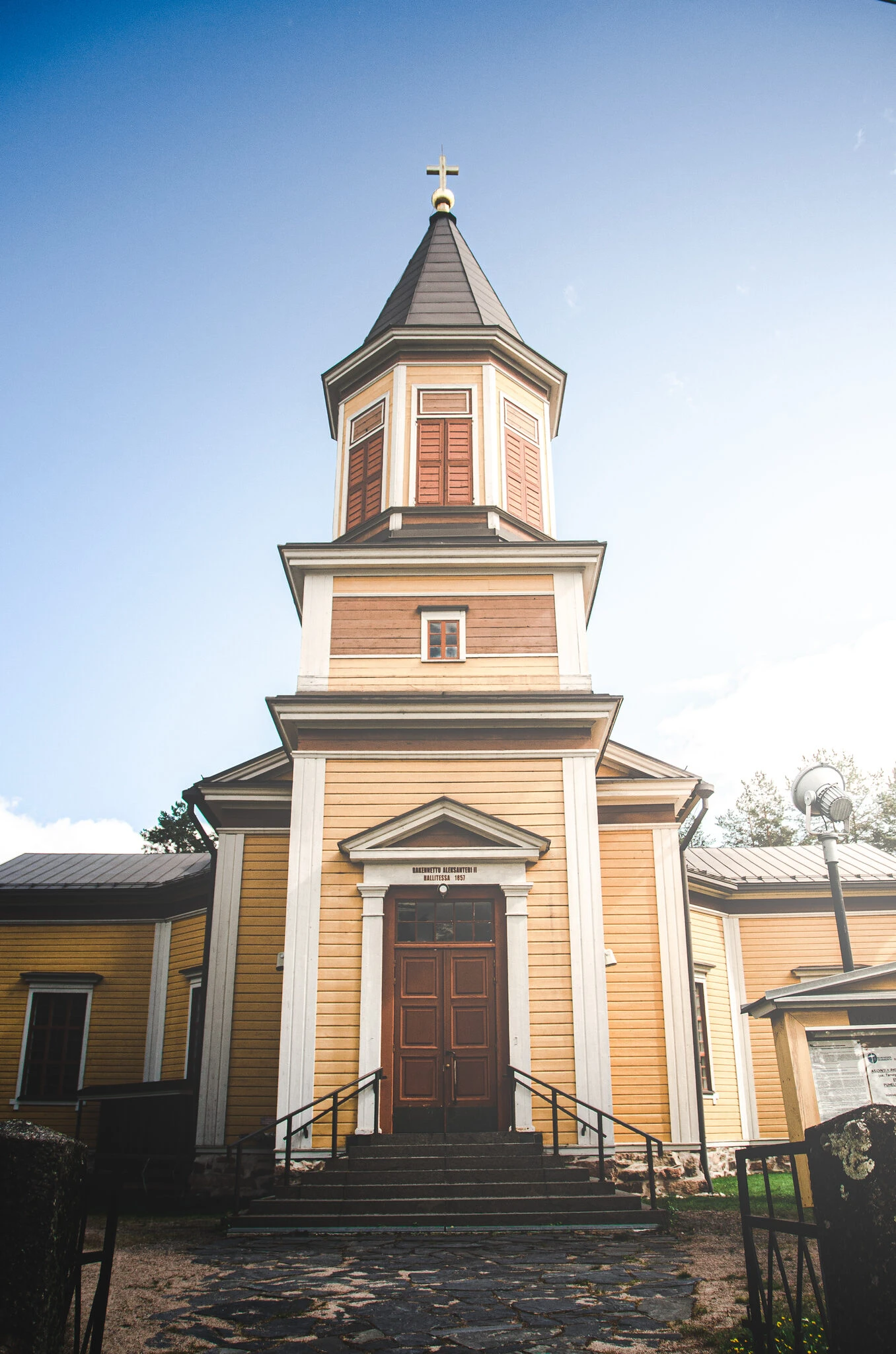
Vesanto Church
The people of Vesanto built their wooden church during the winter of 1856–57 under the direction of Mikko Karjalahti, a church builder from Haapajärvi. The official drawings were made by provincial architect Carl Ziegler. The church was consecrated on 23 July 1857 by C. A. Höök, the acting vicar of Rautalampi.
The church has since undergone several repairs, including in 1952 and 1995, although the building has never fallen into particularly poor condition. The most recent renovation was carried out in 2005–2006, during which the church was repainted both inside and out. Electrical and fire safety systems were renewed, as well as the sound system. The bell‑ringing system was automated and the organ was re‑voiced.
In the church hill area, next to the stone wall by the road, stands the sculpture “Kaskikivet” by artist Anu Matilainen from 1988. It is a monument to cooperative activity in Vesanto. In the hollow of the stones is a mustard seed, from which a great tree grows through cooperation. The church in the background reflects the biblical metaphor that only God can give growth.
The history of Vesanto Church’s altarpiece is unusual. The painting, once discarded, was found by Toivo Jäntti, a soldier from Sonkari, Vesanto, in 1941 in the village of Grisinskoje in Aunus Suistamo. With the permission of his battalion commander, he brought it home to adorn his local church. Thus, the “Blessing Christ” by an unknown artist continues to call worshippers to the altar.
The altar was detached from the wall in the 1980s to follow traditional Christian practice. Around the same time, the altar was decorated with church textiles designed by textile teacher Marja Korhonen from Vesanto. Notably, the green textile series features shades found in Vesanto’s natural landscape, with blackcurrant — the “Vesanto vine” — as its motif, symbolising Jesus’ parable: “I am the vine, you are the branches. If you do not remain in me, you cannot bear fruit.”
Near the altar stands a baptismal font made of green Kolmården marble, donated by Vesanto’s post‑war partner municipalities in Sweden. On the wall hangs the Rautalampi wedding ryijy.
The church received its first organ in 1890. The present organ, with 20 stops and electro‑pneumatic mechanics, was installed in 1957 and was built by the Kangasala Organ Factory.
The bell tower is integrated with the church above the main entrance. Its gilded cross shines especially brightly over the village in the light of the setting sun.
Originally, the tower housed a smaller bell pitched in G, brought from St. Petersburg by the owner of Pentinmäki even before the church was completed. The newer bell, from 1907, is pitched in C. For more than 40 years, the bells were rung manually by Elli Laulainen, who prayed:
“May the bells of our church ring across the land, giving praise and honour to God!”
Today, the bells are rung automatically.
Address:
Koulutie 1, 72300 Vesanto